
The Frustration of a Thermostat That Won’t Budge
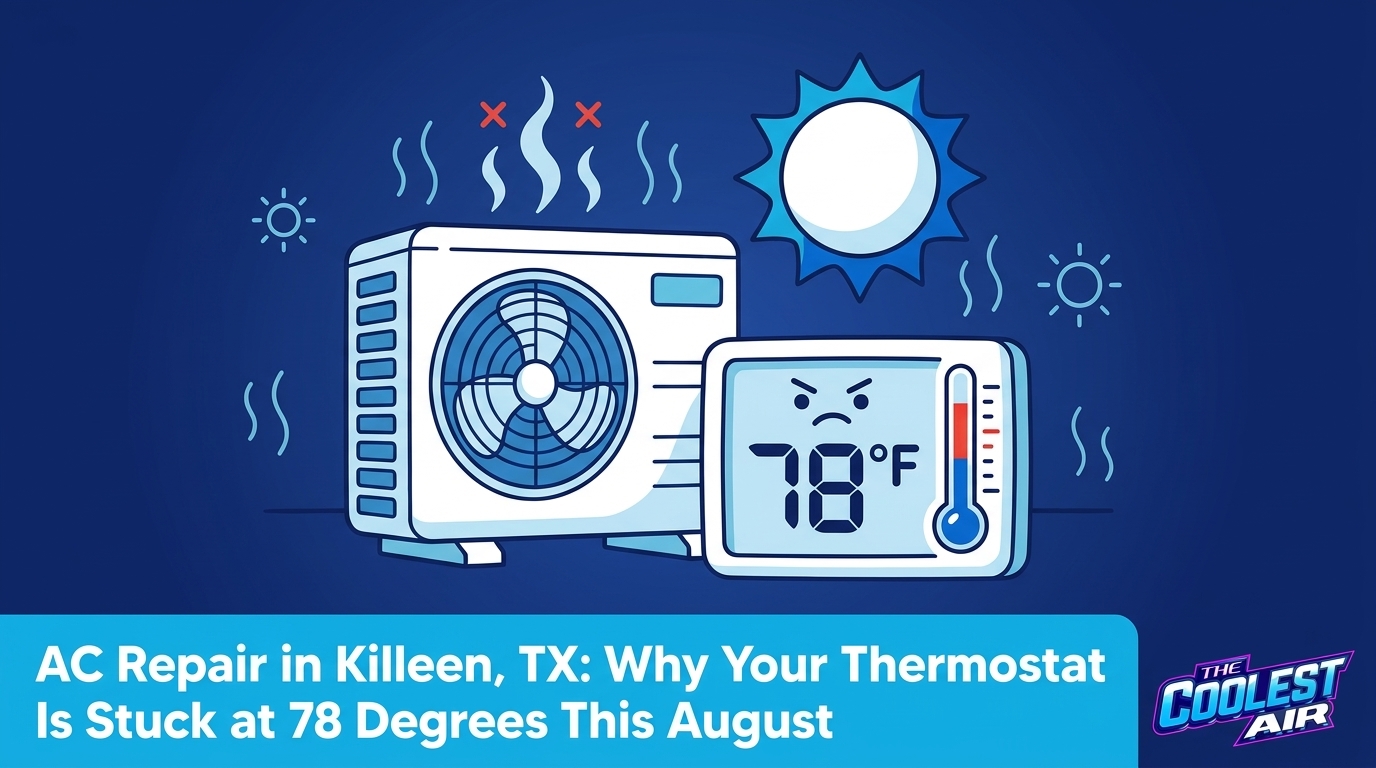
Your air conditioner is running nonstop, but the house still feels uncomfortably warm. If you are searching for AC Repair in Killeen, TX: Why Your Thermostat Is Stuck at 78 Degrees This August, you are certainly not alone in your frustration. The system hums endlessly, yet the indoor temperature refuses to drop a single degree. In our years serving the Killeen area, our team at The Coolest Air has seen firsthand how the immediate discomfort of sweating in your own living room is matched only by the sinking worry that your cooling system is on the verge of a catastrophic breakdown.
For trusted AC services in Killeen, reaching out to a local expert is the fastest path to restoring your comfort.
August in Central Texas brings extreme, prolonged heat waves where ambient temperatures frequently exceed 100 degrees. When the weather outside is that punishing, your HVAC system works overtime just to maintain a livable environment. The critical decision you face right now is determining whether your system is simply maxed out by this extreme seasonal heat, or if it has suffered a mechanical failure that requires immediate professional intervention.
Here is the reassuring truth: a thermostat stuck at 78 degrees does not automatically mean your equipment is broken. Before you panic about an expensive replacement, it helps to understand exactly how your equipment is designed to operate under severe stress. Knowing what is happening behind your vents can save you from unnecessary worry and help you make an informed choice about when to call for help.
The Physics of Cooling: Understanding the 20-Degree Rule
The Problem: You have the thermostat set to a crisp 72 degrees, but the digital display stubbornly reads 78. The air blowing from the vents feels cool, yet the house is simply not reaching your target temperature.
The Cause: This plateau often comes down to the fundamental physics of residential cooling, governed by something called the 20-degree rule, or “Delta T.” Air conditioners do not magically create cold air; they remove heat and humidity from the air inside your home. The American Society of Heating, Refrigerating and Air-Conditioning Engineers (ASHRAE) sets design standards for residential systems, and those standards dictate that a standard air conditioner is sized to maintain a maximum temperature difference of about 20 degrees between the indoor air and the outdoor air.
Let’s look at the math for Killeen, TX. On a brutal August afternoon when the outdoor temperature hits 105 degrees, your air conditioner is operating at 100% of its designed capacity just to cool the house down to 85 degrees. If your indoor temperature is sitting at 78 or 80 degrees during peak afternoon heat, your system is actually overperforming. Expecting a standard residential unit to maintain a 70-degree indoor climate during a 105-degree heatwave is physically impossible without heavy commercial-grade equipment.
The Solution: As honest local experts, our technicians at The Coolest Air believe in educating homeowners on these design limits rather than immediately pushing unnecessary service calls for weather-related capacity issues. Understanding this limitation allows you to manage expectations during heat waves. You can supplement your comfort by keeping blinds closed during the day, utilizing ceiling fans to create a wind-chill effect, and avoiding heat-generating activities like baking until the sun goes down.
How Delta T Impacts Indoor Comfort
Delta T specifically refers to the difference between the return air temperature (the warm air being pulled into your system) and the supply air temperature (the cold air blowing out of your vents). If your system pulls in 78-degree air and blows out 58-degree air, it is achieving a perfect 20-degree drop. Running the system continuously will not bypass this physical limit. The unit will simply keep cycling that air, maintaining the 20-degree differential against the oppressive heat radiating through your roof and walls.

Design Limit vs. Mechanical Failure: How to Tell the Difference
If your thermostat is stuck at 78 degrees, how do you know if the system is just working hard or hardly working? Identifying the difference between a system maxed out by the weather and one suffering a mechanical failure comes down to observation.
First, check the temperature of the air coming out of your supply vents. You can do this simply by holding your hand near a register, or for more accuracy, placing a standard digital meat thermometer into the vent for a few minutes. The air should feel noticeably colder than the room temperature—ideally 15 to 20 degrees colder. If the air feels lukewarm or barely cool, you have a mechanical issue.
Next, pay attention to the cycling behavior. A system working at its design limit on a hot day will run continuously, which is normal. However, if the system is short-cycling—turning on for three minutes, shutting off, and immediately turning back on—or making unusual grinding or squealing noises, a breakdown is imminent. Additionally, you must consider the time of day. If the outdoor temperature drops significantly in the evening but the indoor temperature remains stuck at 78, it signals a malfunction. Finally, rule out simple sensor issues; sometimes the unit is working fine, but inaccurate thermostat readings cause the system to behave erratically.
Signs Your AC is Operating Normally vs. Failing
| Normal Operation (Design Limit) | Mechanical Failure (Red Flags) |
|---|---|
| Air blowing from vents is distinctly cold. | Air blowing from vents is warm or room-temperature. |
| System runs constantly during peak afternoon heat. | System short-cycles (turns on and off rapidly every few minutes). |
| Indoor humidity levels remain comfortable and dry. | House feels muggy, sticky, and unusually humid indoors. |
| Indoor temp drops quickly after the sun goes down. | System struggles to cool even late into the evening. |
| Outdoor unit sounds like a steady, smooth hum. | Ice forms on indoor coils or outdoor refrigerant lines. |
Common Culprits Behind a Stalled AC in Late Summer
If you have determined that your system is exhibiting red flags rather than just battling the August late-summer peak heat, there are a few usual suspects to blame. Late summer is notorious for exposing weaknesses in residential cooling systems. Months of continuous operation take a toll, and minor inefficiencies can quickly escalate into full system stalls.
When an air conditioner plateaus and fails to reach the set temperature despite running constantly, our technicians typically trace the problem back to one of these four mechanical failures:
- Restricted Airflow from Dirty Filters: Over the course of the summer, your air filter traps dust, pet dander, and pollen. By August, a neglected filter acts like a brick wall, suffocating the system. When the blower motor cannot pull enough warm air across the indoor coils, the cooling process halts.
- Frozen Evaporator Coils: It sounds counterintuitive that an air conditioner would freeze solid during a 100-degree heatwave, but it happens frequently. A lack of airflow (from that dirty filter) or low refrigerant causes the temperature of the indoor evaporator coil to drop below freezing. The condensation on the coil turns to ice, completely blocking the flow of cold air into your home.
- Low Refrigerant Levels: Air conditioners do not “use up” or “burn off” refrigerant like a car burns gas. It operates in a closed loop. If your system is low on refrigerant, it means there is a physical leak in the copper lines or coils. This requires professional AC repair to locate the leak, seal it, and recharge the system to the manufacturer’s precise specifications.
- Blocked Condenser Units: The outdoor unit (condenser) is responsible for releasing the heat absorbed from your home into the outside air. By late summer, overgrown vegetation, tall grass, or a buildup of dirt and debris can blanket the unit. If the heat cannot escape, the system cannot cool the inside of your house.
These issues often require prompt attention. For example, our team recently helped a local homeowner whose older A/C unit was leaking badly and struggling to cool their living space. One of our technicians diagnosed the issue without pressure, provided clear options, and fixed the unit in about two and a half hours, restoring their comfort efficiently.
The Toll of August Heat on Aging HVAC Components
Beyond the common culprits of filters and coils, the sheer duration of the cooling season plays a massive role in system stalls. At The Coolest Air, we call this cumulative seasonal stress—a pattern we see often as kids head back to school and end-of-season heat waves push aging systems past their breaking point. The electrical and mechanical components that survived the relatively milder days of June and July frequently fail during the August late-summer peak heat.
The relentless, uninterrupted heat of Central Texas summers accelerates wear on vital electrical parts, particularly capacitors. A capacitor acts like a heavy-duty battery that provides the massive jolt of electricity needed to start the compressor and fan motors. Because they are located in the outdoor unit, they are subjected to intense ambient heat plus the heat generated by the system itself. When a capacitor degrades and fails, the fan might spin, but the compressor will not engage—meaning your system will blow warm, unconditioned air throughout the house.
Compressor motors also face severe thermal overload risks. When the system runs 24/7 to combat 100-degree days, the compressor never gets a chance to cool down. Eventually, it can overheat and trip its internal safety switches, shutting down the cooling cycle entirely while the indoor fan continues to run.
This cumulative wear is exactly why proactive care is so vital. Scheduling routine AC maintenance helps mitigate these end-of-season breakdowns by ensuring electrical connections are tight, moving parts are lubricated, and failing components are swapped out before they leave you sweating in the dark. In some cases, qualifying for generic energy rebates or federal tax credits on high-efficiency replacement units can help offset costs if a system is beyond repair, though we always recommend verifying current incentive programs with your utility provider or a tax professional.
Actionable Steps Before Calling for AC Service
If your thermostat is stuck at 78 degrees and you suspect a problem, there are several safe, non-DIY troubleshooting steps you should take before picking up the phone. Sometimes, the fix is simpler than you expect.
- Check and replace the air filter: Pull out your indoor air filter and hold it up to a light. If you cannot see light passing through it, it is clogged and needs to be replaced immediately.
- Verify thermostat settings: Ensure the thermostat is explicitly set to “Cool” and the fan setting is on “Auto” rather than “On.” If the fan is set to “On,” it will blow air continuously, even when the compressor is resting, which can feel like warm air coming from the vents.
- Inspect all interior vents: Walk through your home and ensure all supply and return vents are fully open. Make sure no heavy furniture, rugs, or curtains are blocking the airflow. Closing vents in unused rooms actually increases pressure and makes your system work harder.
- Clear the outdoor unit: Go outside and look at the condenser. Carefully remove any leaves, twigs, or debris resting on top of the fan grate. Ensure there is at least two feet of clear space around the entire unit by trimming back late-summer vegetation.
- Check the breaker panel: Occasionally, a power surge or an overheated system will trip the dedicated circuit breaker. Check your electrical panel to ensure the AC breaker has not flipped to the neutral or off position.
A word of caution: Never attempt to open access panels, handle refrigerant lines, or test high-voltage electrical components yourself. These systems carry lethal voltage and highly pressurized chemicals. Any internal diagnostics must be handled by a licensed professional.
When It Is Time to Call an Expert for AC Repair in Killeen, TX: Why Your Thermostat Is Stuck at 78 Degrees This August
If you have verified that the filter is clean, the vents are open, and the outdoor unit is clear, yet the system still blows warm air or fails to cool down after sunset, it is time to call in the professionals. Letting a struggling system run continuously when it is malfunctioning is incredibly risky. You can easily turn a minor repair, like a failed capacitor, into a catastrophic failure, such as a burnt-out compressor, simply by forcing the unit to run while compromised.
Having a local technician who understands the specific extremes of the Central Texas climate makes all the difference in getting an accurate diagnosis. We know exactly how a Killeen, TX heatwave impacts system pressures and electrical loads.
During a recent late-summer stretch of days reaching over 100 degrees, we helped a local family whose AC stopped working entirely, requiring a new compressor to handle the extreme heat. Realizing the urgent need for cooling, our responding technician drove two hours just to obtain the needed part, ensuring the unit was repaired and back in service to keep the family safe. At The Coolest Air, that is the level of dedication we bring to beating the Texas heat.
Frequently Asked Questions
Why is my AC running but the temperature is not dropping?
If your AC runs constantly without lowering the temperature, it is either operating at its maximum thermal design limit during extreme heat, or it has suffered a mechanical issue. Common mechanical causes include a severely clogged air filter, frozen evaporator coils, or a refrigerant leak. If the air from the vents feels warm, shut the system off and call a professional.
What is the 20 degree rule for AC?
The 20-degree rule, or Delta T, refers to the standard cooling capacity of residential air conditioners. These systems are designed to cool the indoor air by a maximum of roughly 20 degrees compared to the outside temperature. If it is 100 degrees outside, an indoor temperature of 80 degrees means the system is operating perfectly within its designed limits.
Is 78 a good temperature for AC in summer?
Yes, 78 degrees is widely recommended by energy experts as the ideal balance between indoor comfort and energy efficiency during the summer. Keeping your thermostat at 78 reduces the strain on your compressor and significantly lowers your monthly utility bills while keeping the indoor humidity at a comfortable level.
Why won’t my AC cool below 75 degrees?
Your AC may struggle to cool below 75 degrees if the outdoor temperature is excessively high (above 95 degrees), effectively maxing out the unit’s cooling capacity. Alternatively, the system may be undersized for your home’s square footage, lack adequate insulation, or be suffering from restricted airflow due to a dirty filter.
Can a dirty air filter cause my thermostat to get stuck at a certain temperature?
Absolutely. A dirty air filter severely restricts the volume of air flowing over the indoor evaporator coils. Without enough warm indoor air passing over the cold coils, the system cannot remove heat effectively, causing the indoor temperature to plateau or even rise while the unit runs endlessly.
Dealing with a stubborn air conditioner during a heatwave is stressful, but understanding the root cause puts you back in control. Whether you are dealing with a system pushed to its design limits or a true mechanical breakdown, taking prompt action protects your equipment and your comfort. If you need AC Repair in Killeen, TX: Why Your Thermostat Is Stuck at 78 Degrees This August, lean on our experienced team at The Coolest Air to diagnose the issue accurately. The right expertise will get your system running smoothly again, giving you the reliable, cooling relief you deserve.